Graphite, Manganese & Rare Earths: The Hidden Materials Behind Batteries, Magnets, and Clean Energy
Clean energy is not built on lithium alone. Graphite, manganese, and rare earths are critical to batteries, magnets, wind turbines, and electric vehicles, making their supply chains central to the future of electrification.
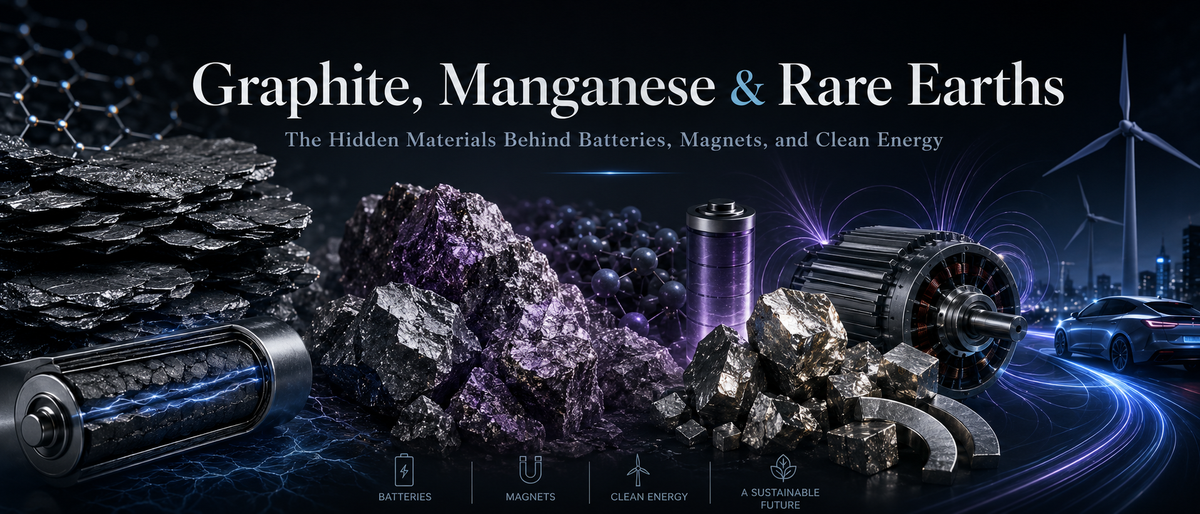
Graphite, manganese, and rare earths could be considered as modern titans, and they're driving our modern world. In the pockets of billions of people sits a marvel of modern engineering: the smartphone. In many garages, a silent "revolution" is parked in the form of electric vehicles (EVs). These technologies, along with the wind turbines dotting our horizons and the advanced medical devices in our hospitals, depend on a specific group of materials that often go unnoticed by the average consumer. They are the invisible backbone of the 21st century.
As the world pivots toward a carbon-neutral economy, the demand for these strategic minerals is skyrocketing. But what exactly are those materials, where do they come from, and why are they so critical to our future?
Rare Earth Elements: The "Vitamins" of Modern Industry
Despite their name, rare earth elements (REEs) are not particularly rare in the Earth's crust. Elements like cerium are more abundant than copper. However, they are rarely found in concentrated, economically exploitable deposits, making them "critical raw materials".
What are they?
The REE family consists of 17 chemical elements: the 15 lanthanides (such as Neodymium, Praseodymium, and Dysprosium) plus scandium and yttrium. They are typically divided into Light REEs (LREEs) and Heavy REEs (HREEs) based on their atomic mass.
Where are they found and extracted?
Historically, the global supply has been dominated by China, which currently accounts for approximately 70% of production and 85% of processing. Other significant deposits are located in the United States (Mountain Pass), Australia (Mount Weld), Myanmar, and Madagascar.
Extraction is a multi-stage, energy-intensive process. It begins with mining and beneficiation, where the ore is crushed and ground before mineral separation via flotation. This is followed by chemical extraction, using strong mineral acids to leach the elements into a solution. Finally, purification and separation occur through complex solvent extraction or ion exchange to isolate individual high-purity oxides.
Why are they important?
REEs possess unique magnetic, luminescent, and catalytic properties. Their most critical application today is in Rare Earth Permanent Magnets (REPMs), specifically Neodymium-Iron-Boron (NdFeB) magnets. These magnets are essential for electric vehicle monitors and wind turbine generators because they provide the strongest magnetic field for their size and weight. Without them, the miniaturization of electronics, from smartphones to hard disc drives, would be impossible.
Graphite: The King of the Anode
While lithium gets the headlines in the battery world, graphite is the silent workhorse that makes high-performance energy storage possible.
What is it?
Graphite is a form of pure carbon where atoms are arranged in sp2-hybridized layers. These layers are held together by weak van der Waals forces, allowing lithium ions to "intercalate" or sit between the layers during battery charging.
Where is it found?
Natural graphite is mined from deposits of metamorphic rocks. Like REEs, China is a major producer, but it is also found in countries like Brazil, India, and Canada. However, a significant portion of battery-grade graphite is synthetic, manufactured through high-temperature treatment of petroleum coke.
Why is it so important?
Graphite has an incomparable balance of low cost, high energy density, and a very long cycle life. It currently holds a staggering 98% market share as the anode material for lithium-ion batteries. Every EV battery requires dozens of kilograms of graphite to function.
Shaping the Future
Researchers are now working on Silicon/Graphite (Si/G) composites. Silicon has a theoretical capacity 10 times that of graphite, but it swells and breaks down during use. By combining silicon with the structural stability of graphite, engineers are creating a new generation of anodes that could significantly increase the range of EVs and the life of our smartphones.
Manganese: The Industrial Workhorse
Manganese is the 12th most abundant element in the Earth's crust and has been a staple of the steel industry for over a century.
Where is it found and extracted?
Manganese is widely distributed in rocks, soil, and water. Major mining operations exist in South Africa, Australia, and Gabon. It is extracted via traditional mining and then processed into ferroalloys of steel or chemical-grade manganese for batteries.
Why is it important?
Beyond its role in making steel together, manganese is a vital component in battery cathodes. The Lithium Manganese Spinel (LiMn2O4) cathode is favored because it is cheap, environmentally friendly, and offers high-rate performance.
Furthermore, manganese is an essential trace mineral for life. In humans and animals, it acts as a cofactor for enzymes necessary for bone growth, fat metabolism, nervous system function, and reproduction. In plants, it is required for chlorophyll synthesis and photosynthesis.
The Challenges: Supply Risk and Environmental Impact
The reliance on these materials comes with a cost. The concentration of supply chains in a single region creates vulnerabilities to disruption. Furthermore, traditional extraction can lead to land degradation, water pollution, and the release of toxic or radioactive byproducts such as thorium or uranium.
To mitigate these risks, the world is looking toward alternative resources:
- Deep-Sea Sediments: The ocean floor contains vast amounts of REEs in ferromanganese crusts and nodules.
- Coal Byproducts: Coal fly ash, a waste product of a power plant, has been identified as a promising source of REEs.
- Industrial Waste: "Red mud" from aluminum products and phosphogypsum from fertilizer manufacturing also contain recoverable concentrations of critical minerals.
The Recycling Frontier: Urban Mining
As primary ores deplete, recycling (or "urban mining") is becoming the new gold rush.
Neodymium Magnets
Recovering REEs from end-of-life (EoL) products like computer hard disk drives (HDDs) and EV motors is a major focus. Innovative methods like hydrogen decrepitation use hydrogen to break down magnets into a powder, making extraction easier. Researchers are also testing organic acids (such as acetic or citric acid) as eco-friendly alternatives to harsh mineral acids for leaching REEs from waste magnets.
Graphite and Battery Waste
Recycling the graphite from spent lithium-ion batteries can reduce production costs and environmental impact. While recycled graphite often has structural damage, new regeneration technologies are being developed to restore its battery-grade properties.
Conclusion
The transition to green energy is fundamentally a material transition. To reach "Net Zero" by 2050, the world will need to intensify the exploration and responsible extraction of graphite, manganese, and rare earths.
The future of these materials lies in circularity. By developing cleaner extraction technologies, such as mechanochemistry (using mechanical force to drive reactions without solvents) and microwave processing, and by perfecting the art of urban mining, we can ensure a steady supply of the building blocks of our high-tech world.
The smartphones in our hands and the EVs on our roads are more than just gadgets; they are the end products of a complex global dance of chemistry and geology. Understanding and mastering these hidden titans is the key to a sustainable, electrified future.
The real question is no longer whether clean energy technologies can scale, but whether the critical material supply chains behind them can scale sustainably, securely, and fast enough.