From α- to β-Spodumene: The Real Bottleneck in Lithium Processing
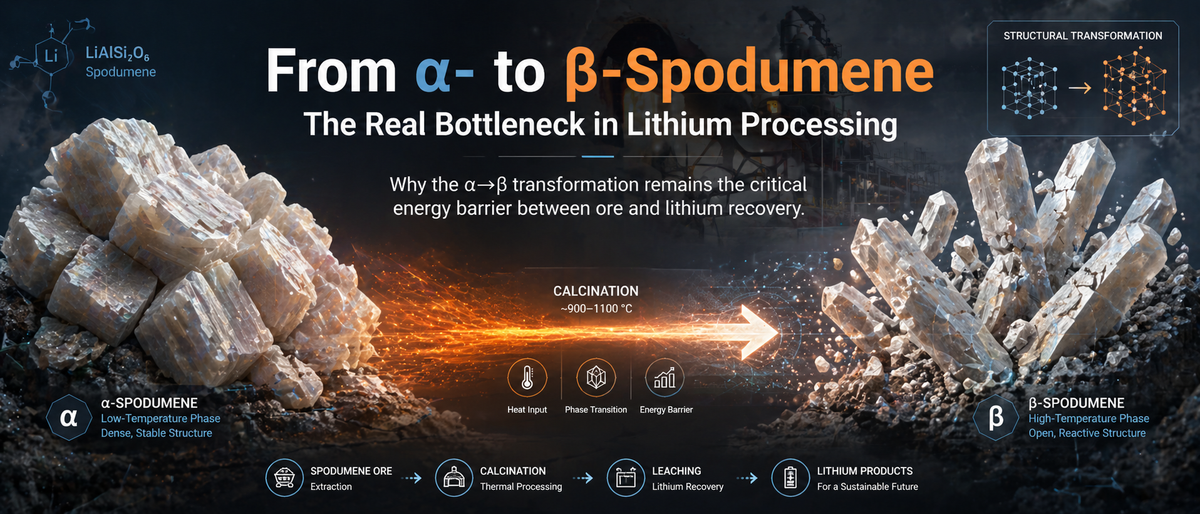
The α→β transformation is the key bottleneck in hard-rock lithium processing. It unlocks lithium recovery from spodumene, but requires energy-intensive calcination that strongly affects process efficiency and economics.
As the world shifts to electric vehicles (EVs) and grid-scale energy storage, the demand for lithium is constantly growing. To meet the surge, industry relies heavily on spodumene (LiAlSi2O6), the most economically significant hard-rock lithium mineral due to its high lithium content (theoretically up to 8.03% Li2O. This corresponds to Li content of 3.73% in the pure spodumene.
However, there is a hidden struggle at the heart of every spodumene refinery. Before a single gram of lithium can be extracted to make a battery, the mineral must undergo a violent, energy-intensive metamorphosis. This transition from α-spodumene to β-spodumene is not just a chemical step; it's the defining bottleneck of the entire lithium industry.
The Crystal Fortress: What is α-spodumene?
Nature does not give up its lithium so easily. Spodumene naturally occurs in the α-phase, a monoclinic pyroxene with a highly compact and dense crystal structure (3.27 g/cm3). In this state, lithium atoms are tightly trapped within cavities between silicon-oxide tetrahedra and aluminum-oxide octahedra, held by strong Coulombic forces.
For industrial processors, α-spodumene is "refractory". It is chemically inert and virtually resistant to the attack of common acids and bases at room temperature. You could soak a piece of α-spodumene in concentrated sulfuric acid for days, and the lithium would remain locked inside its crystalline "safe".
The Grand Opening: Unlocking the Structure
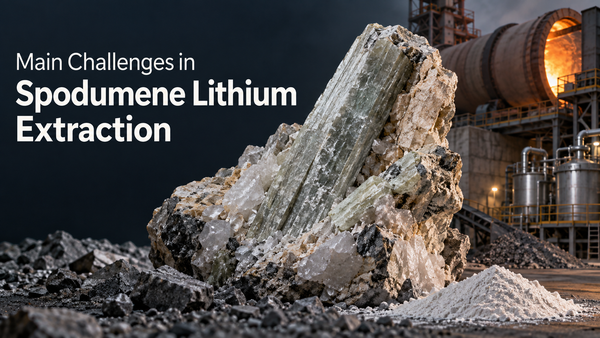
To make the lithium accessible, the industry uses a process called calcination (or decrepitation). Spodumene concentrate is fed into massive rotary kilns and heated to staggering temperatures between 1000 °C and 1100 °C for approximately 2 hours. At these extreme temperatures, the mineral undergoes a radical phase transition:
- The Transformation: The monoclinic α-polymorph "unfolds" into the tetragonal β-spodumene phase.
- The Intermediate: Often a metastable hexagonal γ-phase appears between 800 °C and 950 °C before the final β-spodumene.
- Physical Expansion: The most dramatic change is physical. β-spodumene is much less dense (2.4 g/cm3), resulting in a 30% volumetric expansion.
The expansion causes the mineral to become chalky, brittle, and porous. More importantly, the new β-structure contains zeolite-like channels that allow Li+ ions to move freely. This makes the lithium finally amenable to chemical attack via ion exchange with hydrogen (H+) or sodium (Na+) in downstream leaching.
Why This Phase Transition is the Industrial Bottleneck?
If the β-transition is so effective, why is it considered a bottleneck? The answer lies in the massive economic and environmental toll it takes on production.
A. Massive Energy Intensity
Heating thousands of tons of rock to 1100 °C is a monumental engineering feat. Calcination is identified as the most energy-intensive step in the lithium extraction process. It requires approximately 1.66 GJ of natural gas and 1.01 GJ of electricity to produce just one ton of lithium carbonate from spodumene.
B. The Carbon Footprint
Because most industrial kilns rely on fossil fuels, the carbon footprint of hard-rock lithium is significantly higher than that of lithium from brines. Producing lithium from spodumene mining can release approximately 37 tons of CO2 per ton of lithium, compared to roughly 11 tons of brines. Specifically, the decrepitation step contributes to a footprint nearly triple that of the brine sector (approximately 9 tons of CO2 per ton of lithium carbonate equivalent).
C. Operational Inefficiency
Industrial kilns often suffer from low efficiency due to temperature gradients and variations in particle size. Larger particles may sinter at the surface while remaining unreacted at the core (the shrinking core model), reducing overall lithium recovery in the downstream leaching stages. Furthermore, heating above 500 °C can trigger the oxidation of impurities, leading to the formation of highly toxic byproducts like arsenic trioxide.
Why hasn't the Industry Shifted to Better Methods?
Researchers have developed several "green" alternatives that bypass the 1100 °C kiln entirely, so why is the high-temperature route still dominant?
- Commercial Maturity: The sulfuric acid roasting process has been the dominant technology for over 70 years. It is a proven, reliable method that achieves high lithium recovery rates of up to 98%.
- The Scalability Gap: While novel methods like low-temperature NaOH roasting (325 °C) or solid-state reactions with Na2CO3 (750 °C) have achieved >90% recovery in labs, scaling them to industrial levels presents massive hurdles. For example, using sodium hydroxide at scale requires highly anti-corrosive and expensive equipment to handle the aggressive caustic reagents.
- Reagent and Waste Challenges: Methods like direct HF leaching achieve 96% mobilization at only 100 °C, but the use of highly toxic hydrofluoric acid raises severe safety and environmental concerns. Bioleaching, while environmentally benign, is currently too slow and inefficient (<4% recovery) for commercial use.
- The "Industry Hesitance": There is a natural industrial resistance to adopting high-pressure treatment (like the Metso-Outotec soda-ash process) due to the high capital investment required for autoclaves compared to traditional kilns.
The Road Ahead: Breaking the Bottleneck
Despite the industry's reliance on the traditional 1100 °C route, the tide is beginning to turn. The surge in lithium demand is forcing a "diversification" of extraction strategies.
New industrial projects, such as the Keliber Project in Finland, are moving toward high-pressure sodium carbonate leaching, which avoids strong acids and aims for a more sustainable "mine-to-battery" loop. Meanwhile, researchers are exploring microwave-assisted calcination, which can produce β-spodumene faster and with less energy than conventional kilns.
Conclusion
The α-to-β phase transition remains the iron gate for the lithium industry. Until we can commercially "unlock" the α-spodumene safe at room temperature without toxic chemicals, the energy-intensive kiln will remain a necessary, if costly, evil. But with every innovation in hydrometallurgy, we move one step closer to a truly green supply chain for the "white gold" of the 21st century.
So the real question is not simply how to convert α-spodumene into β-spodumene more efficiently, but whether future lithium processing should depend on this transformation at all. What do you think? Are we going to build new facilities and adapt new low-temperature processes, or stick to the traditional sulfuric acid processes?
If you want to read how spodumene is processed from ore to the final product, check this post.