What Are the Main Impurities in Spodumene Processing?
Spodumene processing is not only about lithium recovery. Impurities such as quartz, feldspar, iron, sodium, calcium, magnesium, and aluminum-rich phases can strongly affect calcination, leaching, purification, and final product quality.
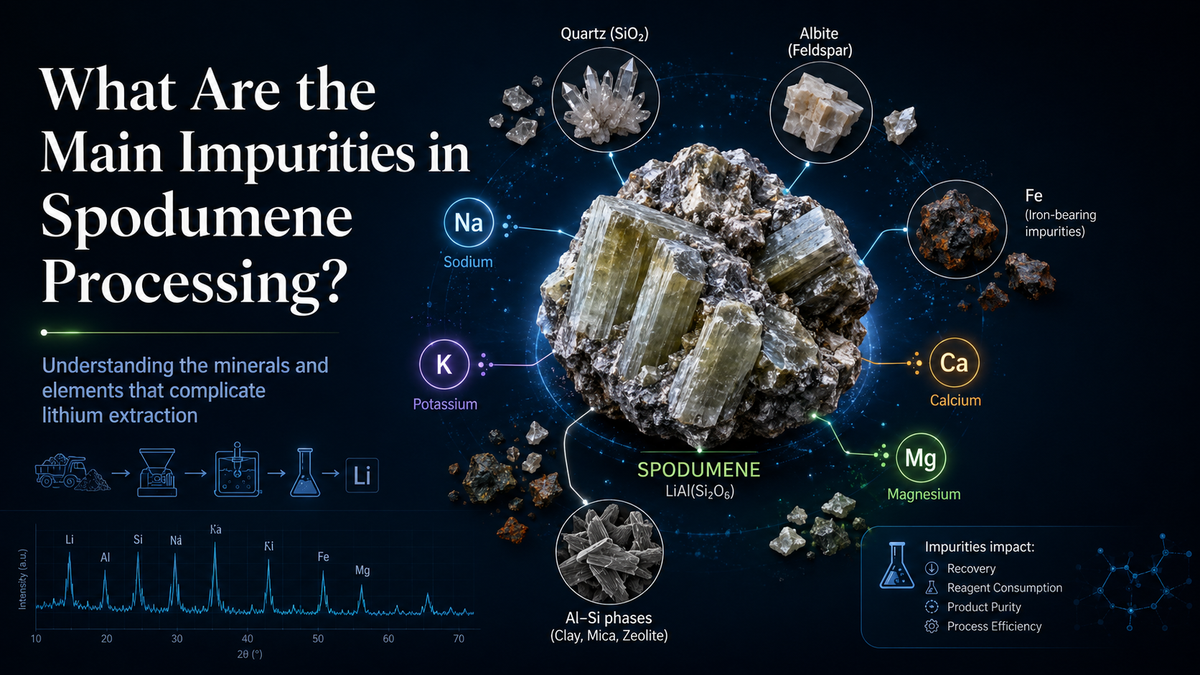
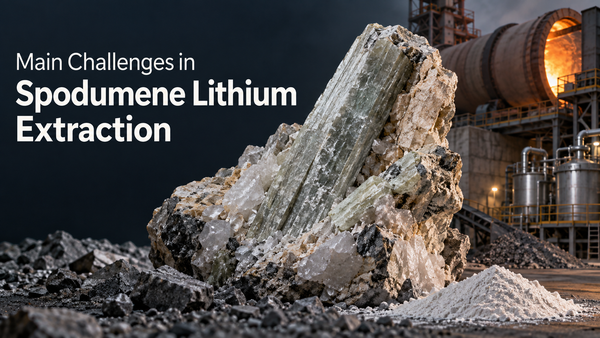
The global push for a carbon-neutral future and the quest for lithium have turned the world upside down, focusing industry attention on the most important primary lithium-bearing silicate mineral: spodumene (LiAlSi2O6). However, extracting battery-grade lithium from the mineral is not as simple as dissolving the rock in acid. Spodumene never exists in a vacuum. It is always accompanied by a suite of "uninvited guests" - mineral and elemental impurities that can make or break the economic viability of a lithium refinery.
To produce a product pure enough for electric vehicle (EV) batteries (typically >99.5% Li2CO3). Even trace amounts of specific elements can ruin a battery's performance, causing capacity loss or safety failures. To master this process, professionals must understand where the impurities come from and how to remove them systematically.
The Mineral "Gatekeepers": Quartz and Albite
Spodumene rarely occurs in isolation. It is typically found in pegmatite deposits alongside a "gangue" (waste) mineral matrix. A typical spodumene concentrate might contain roughly 70% spodumene, with the remaining mineral impurities such as quartz, feldspar (albite), and micas.
Quartz (SiO2)
Usually the most abundant impurity in spodumene pegmatites. While quartz is largely inert during traditional sulfuric acid roasting, it becomes highly reactive in newer alkaline processes. In alkaline systems, quartz reacts with sodium-based reagents to form soluble sodium silicates. This not only consumes expensive reagents, but also creates a "filtration nightmare" by forming viscous silica gels in the leach liquor. Quartz also forms the component host rock. However, during calcination, it remains stable while spodumene expands, which can be used to selectively grind and reject coarse quartz via screening.
Albite (NaAlSi3O8)
A common feldspar mineral considered a double threat because it introduces sodium, aluminum, and silica into the system, and it is prone to forming eutectic mixtures with reagents like sodium carbonate (Na2CO3), leading to sintering or the formation of a molten silicate phase at relatively low temperatures. This "glue" can fuse particles together, trapping lithium inside and preventing the leaching agent from reaching the spodumene core. Because albite has a lower melting point than spodumene, its presence can also cause the ore to "glassify" or sinter in the kiln, creating a hard mass that sticks to the equipment and blocks further chemical attack.
Most quartz and albite are removed during beneficiation (flotation, magnetic separation, or dense media separation) to create a high-grade concentrate (>6% Li2O). If beneficiation is not an option, large amounts of albite can cause significant technical, as well as economic problems.
Micas (Lepidolite/Muscovite)
These sheet-like minerals are often interlocked with spodumene. They are considered impurities because they carry potassium, iron, and magnesium.
Post-Leaching Elemental Impurities
Once spodumene is roasted and leached, either through traditional sulfuric acid digestion or newer alkaline methods, the impurities "wake up" and enter the liquid solution as ions. This is where the real purification battle begins.
Aluminium (Al) and Iron (Fe)
Aluminium is a core component of the spodumene structure itself (LiAlSi2O6) and gangue minerals like muscovite. During acid leaching, it dissolves into the solution as aluminum sulfate. The problem with this metal is that it interferes with the electrochemical stability of the battery cathode.
Iron often enters as an isomorphous substitution within the spodumene lattice or from minerals like biotite or pyrite, but also from corrosion of processing equipment. Even tiny traces of iron cause internal short circuits in the lithium-ion batteries. Both aluminum and iron are considered "poisons" for battery performance.
In the sulfuric acid process, pH is adjusted (neutralized) using limestone (CaCO3) to a range of 5.5-6.5, which causes iron and aluminum to precipitate as hydroxides, which can be filtered out. At pH 3.0-3.5, iron can be removed as geothite or hematite before other valuable metals are lost.
Silicon (Si)
Silicon comes from the breakdown of the silicate lattice of spodumene, albite and quartz. It is considered the "silent killer" of industrial equipment. Dissolved silicon can reach a saturation threshold and polymerize into a "silica skin" or rind on the surface of mineral particles. Following the Shrinking Core Model, this skin acts as a physical barrier that "chokes" the reaction. If it becomes supersaturated, it can easily form a hard, glass-like scale on heat exchangers and membranes (for example, for reverse osmosis). This scale is almost impossible to remove without hazardous chemicals like hydrofluoric acid (HF).
Typically, to remove silicon via desilication, lime (CaO) can be used at temperatures around 95°C to form insoluble calcium silicates (CaSiO3 or Ca2SiO4). Maximum removal efficiency often occurs at a "sweet spot" pH of 9.5-10.5 when using magnesium-based adsorbents.
Calcium (Ca) and Magnesium (Mg)
These are the real challenge. Calcium usually comes from calcite and apatite in the ore, while magnesium comes from micas and the spodumene lattice, or in trace minerals such as dolomite associated with the ore. Magnesium is often called the "chemical twin" of lithium because they have similar ion sizes, which causes magnesium to co-precipitate during the final step, ruining the lithium carbonate purity. Both elements (especially calcium) cause scaling in industrial equipment and interfere with the crystallization of high-purity lithium carbonate. When it comes to removal of Mg, it precipitates as Mg(OH)2 at high pH (at least 12), using hydrated lime, while Ca is removed by adding soda ash (Na2CO3) to precipitate it as CaCO3 at a high pH (11-12).
Sodium (Na)
Sodium is introduced through reagents such as NaOH or Na2CO3 used in leaching and precipitation, and it also comes from albite. While sodium is part of many reagents, its accumulation in the "mother liquor" can reduce the efficiency of a closed-loop system. It remains in the "mother liquor" and can be trapped within lithium carbonate crystals as they grow, so it's usually washed from lithium carbonate or removed by recrystallizing the crude product. In sulfuric acid leaching, during the purification step, sodium is typically removed by crystallizing sodium sulfate (Na2SO4) as a byproduct, which can then be sold or recycled. Still, sodium can be a stubborn impurity in various Li recovery processes, and more about it will be covered in upcoming articles.
The Residue Challenge: Sodium Aluminosilicate
In alkaline roasting processes, new mineral phases like nepheline (NaAlSiO4) or analcime (NaAlSi2O6∙H2O) are formed as byproducts. They are also considered impurities because these phases are the "transformed" versions of the original mineral framework. If they form too quickly or densely, they create a product layer that prevents lithium from escaping the particle. For example, nepheline can be considered a good impurity because it traps silicon, preventing it from reacting with silicon. If the reaction is not perfectly balanced, it often requires the addition of alumina in the system to prevent formation of lithium silicate, which is a dead-end for recovery if water is used for leaching, because lithium silicates are barely soluble in water.
These solids can easily be separated from purified lithium solution through filtration after the leaching stage. While these are technically impurities in the lithium stream, they can be removed and purified and sold as high-value products (depending on the process used for lithium extraction), which have industrial applications in wastewater treatment and catalysis, but also for the cement and ceramic industries.
Conclusion
Purification is the "bottleneck of economic viability" in lithium production. High impurity levels drive up the cost of reagents (like sulfuric acid and lime) and increase the environmental footprint due to the generation of large volumes of acidic or alkaline waste.
Only through a rigorous multi-stage approach, starting with physical beneficiation and ending with precise chemical precipitation, can you transform a common rock into the ultra-pure lithium that powers the modern world.
What do you think? What was the hardest element to purify for you in the downstream?