Main Challenges in Spodumene Lithium Extraction
Extracting lithium from spodumene involves more than achieving high recovery. This article explores how mineral stability, energy-intensive processing, and impurity removal affect efficiency, product purity, and the path to industrial scale.
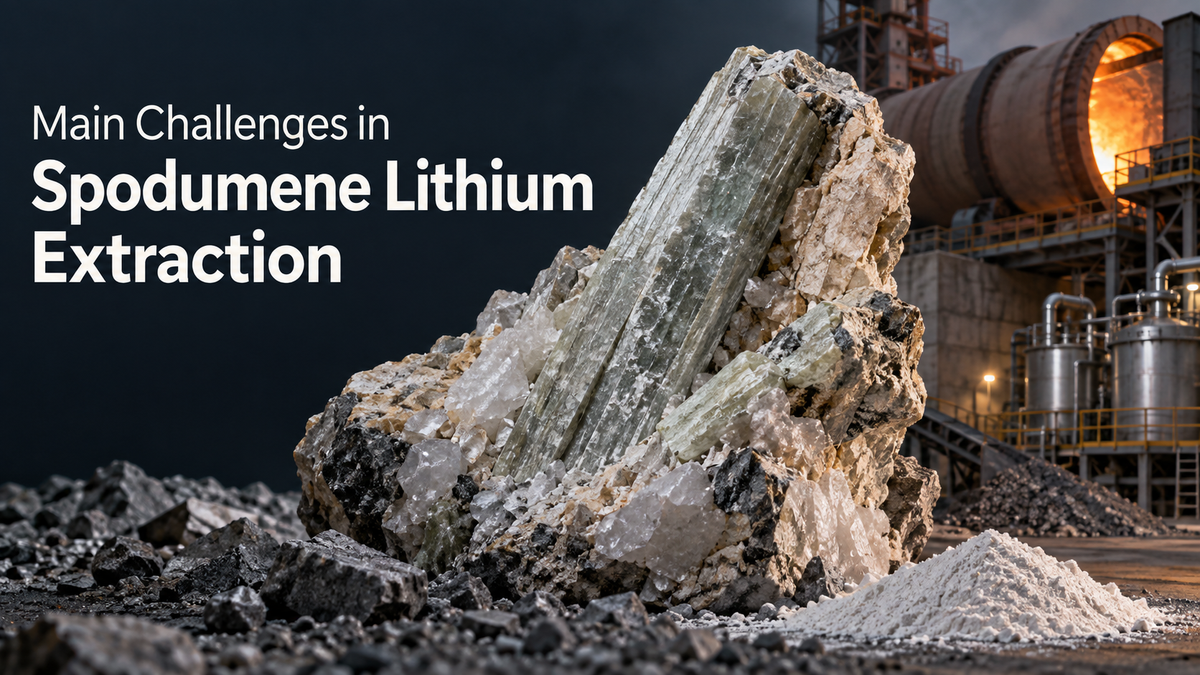
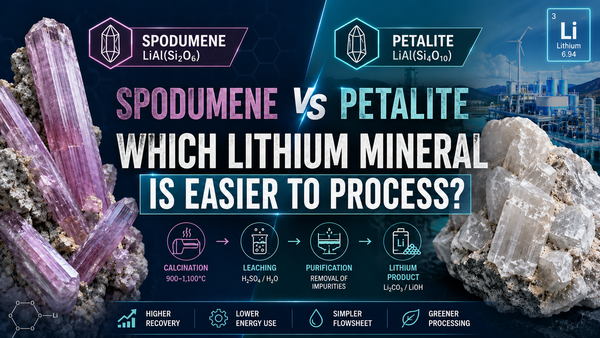
The rapid global shift toward electric vehicles and renewable energy storage has created an unprecedented surge in demand for battery-grade lithium chemicals. To meet this demand, the mining industry relies heavily on hard-rock lithium deposits, especially spodumene (LiAlSi2O6), an inosilicate mineral in the pyroxene group that can theoretically contain up to 8.03% Li2O. While hard-rock extraction offers faster production timelines and greater geographic diversification than continental brine evaporation, it comes with a major caveat. Processing spodumene is notorious for its extreme energy demands, heavy chemical consumption, and environmental footprint. Understanding the core technical, metallurgical, and environmental bottlenecks of spodumene extraction explains why scaling hard-rock refining remains one of the most complex challenges in modern extractive metallurgy.
The Energy Penalty of High Calcination Temperatures
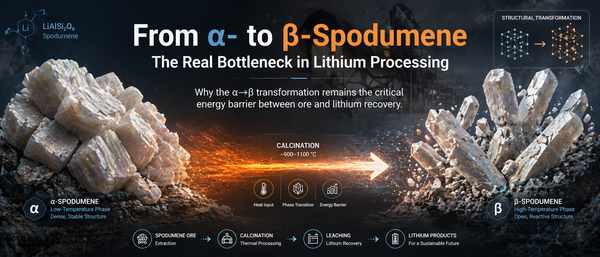
Naturally occurring α-spodumene is a dense, monoclinic pyroxene crystal (3.15-3.27 g/cm3) in which lithium ions are tightly bound within the voids of a compact silicon-oxygen and aluminum-oxygen polyhedron framework. In this natural state, α-spodumene is chemically inert and resistant to attack by almost all standard industrial acids and bases at ambient conditions.
To make the lithium accessible, the concentrate must first undergo a thermal pretreatment known as decrepitation or calcination. Heating α-spodumene to 1000-1100 °C induces a reconstructive, irreversible phase transformation into β-spodumene. This transition causes a dramatic 30% volumetric expansion, dropping the mineral's density to roughly 2.36-2.4 g/cm3 and fracturing the crystal lattice into a porous, chalky structure with zeolite-like channels that allow ion exchange.
However, achieving this phase change requires massive energy inputs. Calcining pure spodumene consumes approximately 2096 kJ/kg (582 kWh/ton) of heat energy just for the thermal phase transformation and sensible heat. Because industrial rotary kilns are primarily powered by fossil fuels, this single unit operation drives up operational costs and elevates greenhouse gas emissions.
Incomplete Phase Transformation and Kinetic Barriers
Converting α-spodumene into β-spodumene is not a simple one-step jump. It involves complex, multi-pathway reaction mechanisms that are highly sensitive to heating rates, thermal history, and particle size distribution. During thermal processing, a metastable intermediate phase, γ-spodumene, a hexagonal stuffed derivative of β-quartz, frequently forms at intermediate temperatures between 700 °C and 950 °C. Depending on process conditions, the transformation can proceed along several parallel corridors:
- Amorphous spodumene —> γ-spodumene —> β-spodumene
- Crystalline α-spodumene —> β-quartzSS —> β-spodumene
- Crystalline α-spodumene —> γ-spodumene —> β-spodumene
- Direct α-spodumene —> β-spodumene
If the kiln temperature profile is inconsistent or the residence time is insufficient, a significant amount of unreacted α-spodumene or untransformed intermediate phases remains in the product. Because α-spodumene cannot be digested by acid or weak reagents, any residual α-phase passes straight through the leaching circuit unreacted, leading to direct lithium losses in the solid slag or tailings.
Particle Sintering and "Silicate Glues"
To avoid the extreme energy penalty of 1100 °C calcination, many emerging processes use salt roasting or alkali-assisted roasting (e.g., mixing α-spodumene with Na2CO3, NaOH, CaO, Na2SO4 at lower temperatures like 325-850 °C).
However, these systems introduce a severe physical challenge: sintering. Sintering is the process of forming a solid mass from loose powder using heat and pressure without melting the material into a liquid.
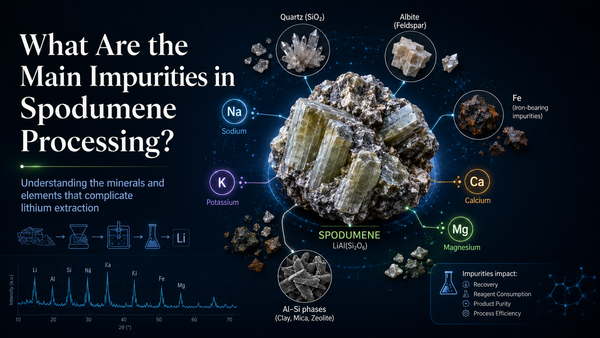
- Formation of Low-Melting Eutectics: Spodumene ores naturally contain gangue minerals like albite (NaAlSi3O8), quartz (SiO2), microcline, and feldspar. When alkaline reagents or sodium salts are added at elevated temperatures, they react with these silica and feldspar gangue minerals to form low-melting sodium silicates and aluminosilicates.
- Encapsulation of Lithium: These molten-phase mixtures act as viscous "silicate glues" that cause the ore particles to agglomerate and stick together into hard, glassy lumps. This agglomeration physically traps unreacted lithium compounds inside a dense solid shell, blocking lixiviants from reaching the active core during downstream leaching.
Aluminosilicate Matrix Breakdown and Silica Gel Behavior
Whether using traditional acid baking or alternative alkali digestion, extracting lithium requires breaking the robust Si-O and Al-O covalent bonds that form the aluminosilicate backbone of the mineral.
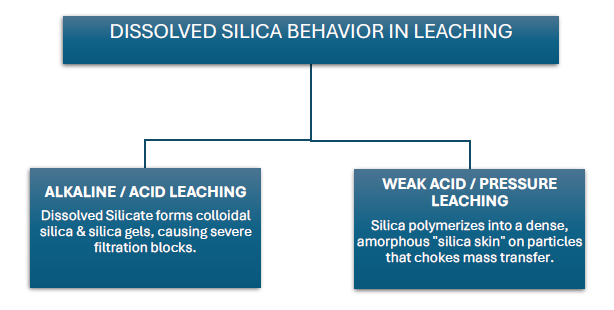
When the silicate framework dissolves, silicon behavior in the liquid phase creates major operational hurdles:
- Colloidal Silica and Silica Gels: In direct acid leaching or alkaline roasting routes (such as NaOH or Na2CO3 digestion), dissolved silicon enters the leach solution as stable silicates. During subsequent neutralization or cooling steps, silicic acid polymerizes to form gelatinous silica gels. These viscous gels drastically increase slurry viscosity and clog filter presses, making solid-liquid separation extremely difficult. In acidic leaching liquors, dissolved silicates tend to polymerize into colloidal silicic acid gels (H4SiO4), which severely slow down solid-liquid filtration circuits. If liquid streams are concentrated using Reverse Osmosis (RO) or Nanofiltration (NF) downstream, residual silica rapidly forms hard, glass-like scales on membrane surfaces, necessitating harsh cleaning chemicals or premature membrane replacement.
- Surface Passivation (the "Silica Skin" Effect): In the weak acid or pressure-leaching systems (such as carbonic acid or autoclaving routes), dissolved silica quickly exceeds its solubility limit. According to the shrinking core model, amorphous silica reprecipitates directly onto the surface of the mineral particles, forming an impermeable, passivating "silica skin" or rind. This rind acts as a physical barrier that chokes proton diffusion into the particle core, causing lithium extraction rates to plateau.
Hydrometallurgical Hurdles: Impurity Dissolution and Massive Reagent Consumption
In the traditional sulfuric acid roasting process (baking β-spodumene with concentrated H2SO4 at 200-250 °C), the chemical attack is fundamentally non-selective.
- Excess Acid Demand: Acid baking requires a massive 30% to 140% stoichiometric excess of concentrated H2SO4. This heavy excess is mandatory because gangue minerals (such as iron oxides, feldspars, and micas) consume acid alongside the target lithium.
- Silicate Byproduct Formation: During alkaline roasting or autoclaving, dissolved silica (SiO2) and alumina (Al2O3) readily react with lithium and sodium to form insoluble or troublesome secondary phases, such as lithium silicate (Li2SiO3), analcime (NaAlSi2O6∙H2O), or nepheline (NaAlSiO4). If lithium becomes locked in Li2SiO3, additional acid washing or complex purification steps are required to recover it.
- Co-Dissolution of Heavy Metal Impurities: The acid co-dissolves substantial quantities of aluminum (Al3+), iron (Fe3+), calcium (Ca2+), magnesium (Mg2+), sodium (Na+), and potassium (K+) into the Pregnant Leach Solution (PLS).
- Multi-Stage Purification Burdens: To yield battery-grade lithium carbonate (Li2CO3) with purity >99.5%, these impurities must be systematically purged. Neutralizing the free acid and precipitating iron and aluminum hydroxides consumes huge amounts of limestone (CaCO3). Subsequent removal of calcium and magnesium requires adding lime milk (Ca(OH)2) and soda ash (Na2CO3). This multi-stage precipitation circuit increases reagent costs and triggers lithium losses via mechanical entrapment in the precipitation solids.
The chemical processing of spodumene is extremely reagent-intensive. Producing 1 ton of Li2CO3 via the standard acid route requires roughly:
- 1.34 tons of high-grade spodumene concentrate
- 0.48 tons of concentrated sulfuric acid (H2SO4)
- 0.52 tons of soda ash (Na2CO3)
- 24.00 tons of process water
To achieve battery-grade purity, multi-stage chemical precipitation, lime (CaO) softening, and ion-exchange polishing steps are required to reduce trace Ca, Mg, Na, and heavy metals. Operating these chemical circuits at an industrial scale requires substantial capital expenditure (CAPEX) for corrosion-resistant materials (to withstand hot H2SO4 or HF) and high operating expenses (OPEX) for continuous chemical supply.
Industrial Scale-Up and Equipment Challenges
Translating laboratory extraction successes into million-ton-per-year industrial refineries exposes several engineering bottlenecks:

- Rotary Kiln Thermal Inefficiencies: Large industrial rotary kilns struggle with temperature gradients and particle size segregation. Larger ore particles require significantly more time for heat to penetrate to their centers, leading to uneven phase conversions and reduced throughput yields.
- The Particle Size Dilemma: Decreasing particle size increases reactivity, but raw α-spodumene ore has a very high Bond Ball Mill Work Index (BBMWI) of 44.9 kWh/ton. Fine grinding of raw ore before calcination requires massive electrical energy and causes severe equipment wear. Furthermore, handling sub-80 micrometer powders introduces severe dust management hazards and material handling issues.
- Pressure Leaching Autoclave Constraints: Advanced acid-free alternatives, such as the Metso-Outotec soda ash pressure leach process, operate at 200-250 °C and 20-22 bar in autoclaves. While effective at eliminating acid waste, pressure leaching requires specialized, capital-intensive, anti-corrosive pressure vessels that are expensive to build and maintain.
Environmental Pressure and Tailings Management
When evaluating hard-rock lithium against continental brine deposits, the environmental comparison strongly favors brines in terms of energy and carbon footprint.
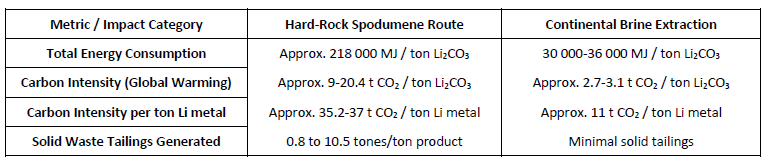
- Carbon Intensity: Producing one ton of Lithium carbonate Equivalent (LCE) from spodumene releases approximately 9 to 20.4 tons of CO2 equivalent (or up to 37 tons of CO2 per ton of refined lithium metal). By contrast, solar brine evaporation emits only 2.7 to 3.1 tons of CO2 per ton of Li2CO3.
- Vast Solid Tailings Accumulation: For every ton of refined lithium carbonate produced, the acid roasting process generates between 0.8 tons (from pure concentrate) and 10.5 tons (from direct ore processing) of acidic aluminosilicate leaching residues. Managing and neutralizing these vast tailings dams represents a significant environmental liability.
- Byproduct Flooding: The final precipitation step produces massive volumes of sodium sulfate (Na2SO4). Because global markets for Na2SO4 are limited, crystallizing or disposing of this salt adds a major waste management burden to hard-rock refineries.
Conclusion
The core challenge in extracting lithium from spodumene lies in breaking a rigid aluminosilicate framework without incurring exorbitant energy, reagent, or environmental costs. While traditional sulfuric acid roasting remains the industry standard due to its high recovery yields (>95%), its high carbon intensity and waste footprint are driving an urgent push for cleaner alternatives.
Whether through low-temperature alkaline digestion, direct pressure leaching, or microwave-assisted calcination, the future of hard-rock lithium refining depends on developing technologies that can overcome these fundamental chemical and physical bottlenecks.
What are your thoughts? Will direct low-temperature alkaline digestion and high-pressure autoclaving eventually replace traditional 1100 °C acid baking, or will electrified rotary kilns keep the traditional route on top of the global lithium market?