Spodumene vs Petalite: Which Lithium Mineral is Easier to Process?
Spodumene and petalite are two important hard-rock lithium minerals, but their processing routes can differ significantly. This article compares their structure, thermal behavior, and leaching efficiency to answer a simple question: which one is easier to process?
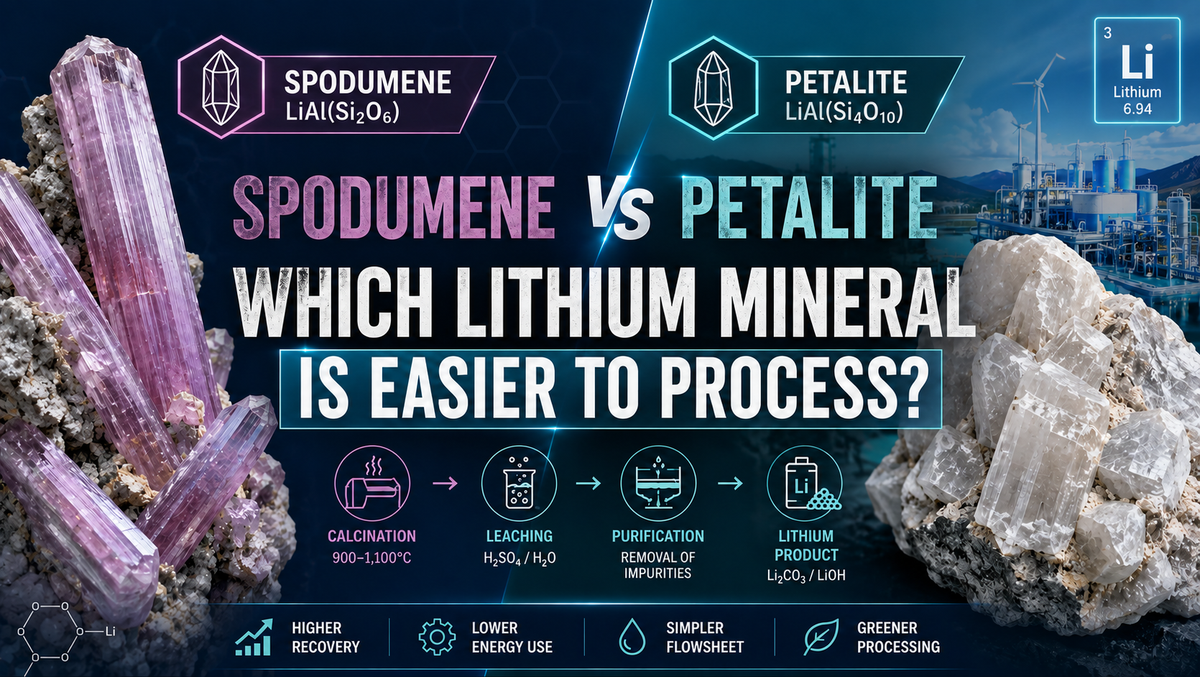
The global transition to a lithium-ion economy has turned pegmatite mining into a high-stakes competition. While lithium can be found in over 145 minerals, two silicates, Spodumene and Petalite, represent the primary targets for hard-rock extraction. Although they often coexist in the same deposits, their molecular architecture makes one a refined industrial champion and the other a complex chemical challenge.
Here is a detailed deep dive into the mineralogical duel: Spodumene vs Petalite.
Atomic Architecture: Chain vs Framework Silicates
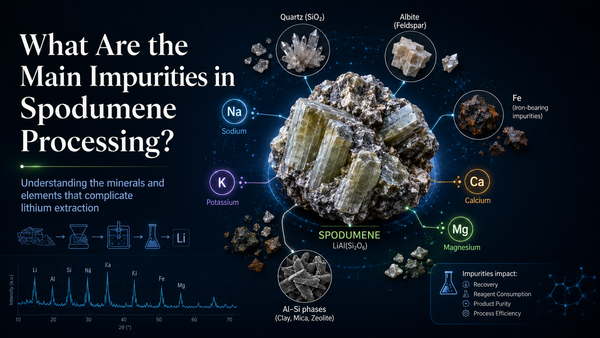
- Spodumene (LiAlSi2O6): A member of the pyroxene group, spodumene is an inosilicate consisting of single chains of silicon-oxygen tetrahedra. In this natural α-spodumene, it is a dense monoclinic crystal (3.15-3.2 g/cm3) where lithium is tightly packed into cavities between Si-centered tetrahedra and Al-centered octahedra.
- Petalite (LiAlSi4O10): This is a tectosilicate (framework silicate). While petalite has a high "iconic porosity" (approximately 63% of empty space, which is technically similar to reactive beta-spodumene), its structure is fully ordered. Critically, its Li-O bonds are significantly shorter (0.194 nm) and more stable than those in the reactive beta-phases of spodumene (0.208 nm), making it more difficult to dislodge the lithium ions.
Lithium Content: The "Grade Gap"
In extractive metallurgy, lithium grade is the single most important factor for economic viability:
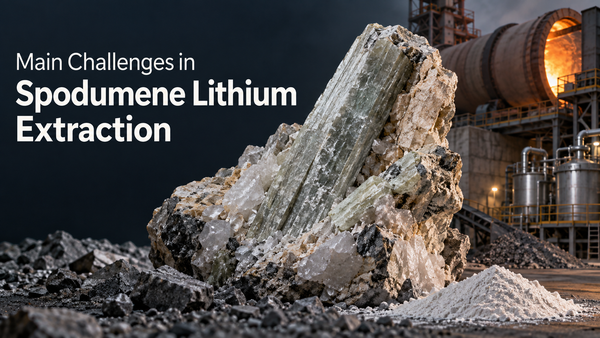
- Spodumene: Boasts the highest theoretical lithium content among commercial silicates at 8.03% Li2O. High-grade commercial concentrates typically achieve 6.0% to 7.6% Li2O.
- Petalite: Much leaner, with a theoretical maximum of 4.88% Li2O. Industrially, this grade gap is a massive penalty. A processor must handle nearly twice the volume of ore to produce the same amount of lithium carbonate (Li2CO3) as a spodumene plant, effectively doubling reagent consumption and transport costs.
Thermal Behavior: The "decrepitation" Step
Both minerals are refractory, meaning they resist chemical attack at ambient conditions and require a high-temperature "thermal unlocking".
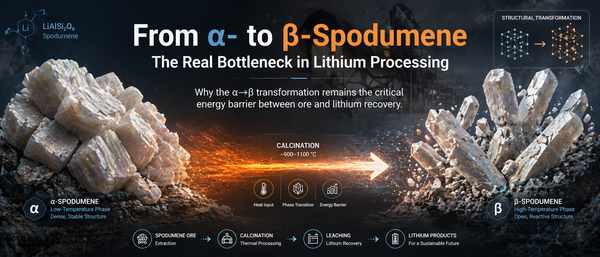
- Spodumene Calcination: Naturally occurring α-spodumene is heated to 1050-1100 ˚C. This includes a phase transition to β-spodumene, causing a massive 30% volumetric expansion. This expansion is a technical blessing: it creates a network of internal cracks, turning a competent rock into a brittle, "chalky" material that reduces the Bond ball mill work index from 44.9 to 25.9 kW/t, making it easy to grind and leach.
- Petalite Calcination: When heated to similar temperatures, petalite transforms into a β-spodumene-SiO2 solid solution. While this transition can be initiated as low as 750 ˚C through solid-state atomic rearrangement, it lacks the violent 30% expansion seen in spodumene. Because the transition maintains "crystallographic coincidence" with the host, the mineral doesn't shatter, remaining physically more competent and harder to process.
Reactivity and Leaching Response
- Spodumene: Once converted into the beta-phase, it is highly reactive due to zeolite-like structural channels that facilitate the counter-diffusion of Li+ and H+. The traditional sulfuric acid process (250 ˚C) achieves recovery rates of up to 98%.
- Petalite: Because of its higher silica content (Si:Al atomic ratio of 4:1 vs Spodumene's 2:1) petalite is prone to the "Silica Trap". During leaching, dissolved silica can reach a saturation threshold and polymerize into a passivating silica skin or rind on the mineral surface. This rind acts as a physical barrier and "chokes" mass transfer, often requiring much higher alkali dosage to achieve structural breakdown.
Why Spodumene Dominates the Industry
Spodumene currently accounts for over 80% of global lithium supply from hard rock. Its dominance is driven by:
- Concentrate Quality: Spodumene is the only hard-rock mineral that can reliably produce a high-grade concentrate (6%+ Li2O) via standard flotation.
- Maturity of Technology: The sulfuric acid roasting method is a proven, reliable industrial standard.
- Resilience and Scale: Deposits like Greenbushes in Australia provide massive, high-quality reserves that dwarf most petalite-dominant pegmatites.
Conclusion
While petalite remains an important resource in regions like Zimbabwe, spodumene is significantly easier and more economical to process at scale. Its higher initial grade, predictable thermal shattering, and the ability of its structure to "open up" for acid attacks make it the undisputed "gold standard" for the battery revolution.
What do you think? As we move toward "greener" extraction methods, like supercritical CO2 leaching or direct solid-state reactions at 750 ˚C, could petalite's framework structure and unique thermal pathways eventually become a processing advantage, or will spodumene's massive Li2O density always keep it on top of the market? Share your thoughts in the comments below.